Space Saturday XII
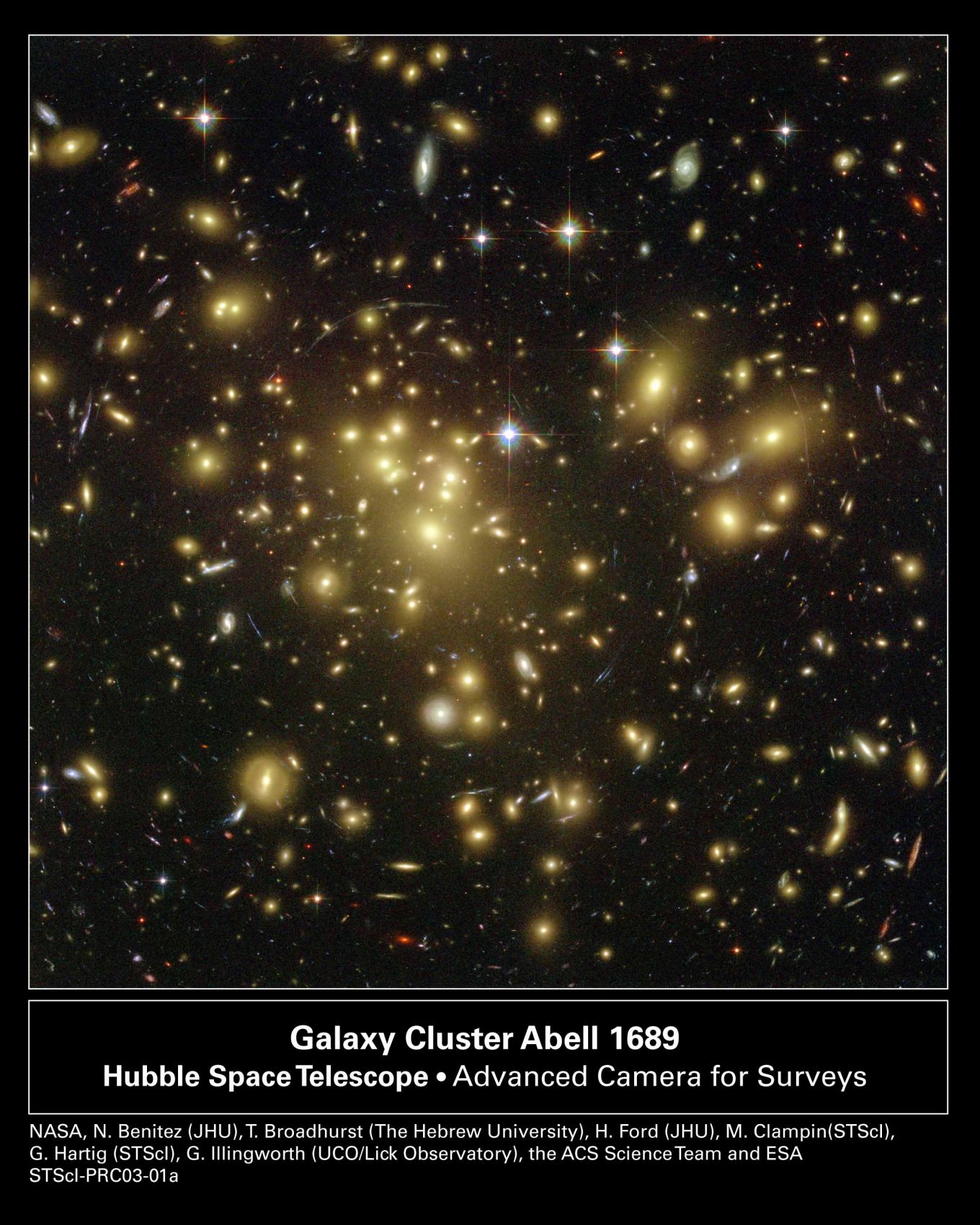
Yes, it is only Friday, but it has been a few weeks since I have posted a Space Saturday and I will be gone this weekend, so there is no time like the present! This week I bring you another of my favoriate astronomy photos: Abell 1689.
Credit: NASA, N. Benitez (JHU), T. Broadhurst (The Hebrew University), H. Ford (JHU), M. Clampin (STScI), G. Hartig (STScI), G. Illingworth (UCO/Lick Observatory), the ACS Science Team and ESA
This is one of my favorite images for a few reasons (click for the larger version, it is incredible!). One is that it gives a good example of how expansive the universe is. This image is a mere 3.2 arcminutes, that is 5 hundredths of a degree, across (for comparison, the moon is about 30 arcminutes - that is, this image is about a tenth the apparent size of the moon). The actual distance across the image is 2 million light years at a distance of approximately 2.2 billion light years! The dots of light? Nearly all are entire galaxies. Abell 1689 is one of the more massive galaxy clusters discovered (named for George Abell’s catalogue of rich clusters of galaxies using the Palomar Observatory Sky Survey). The HST image was captured using its Advanced Camera for Surveys and was able to view the hundreds of galaxies in this small sliver and space.
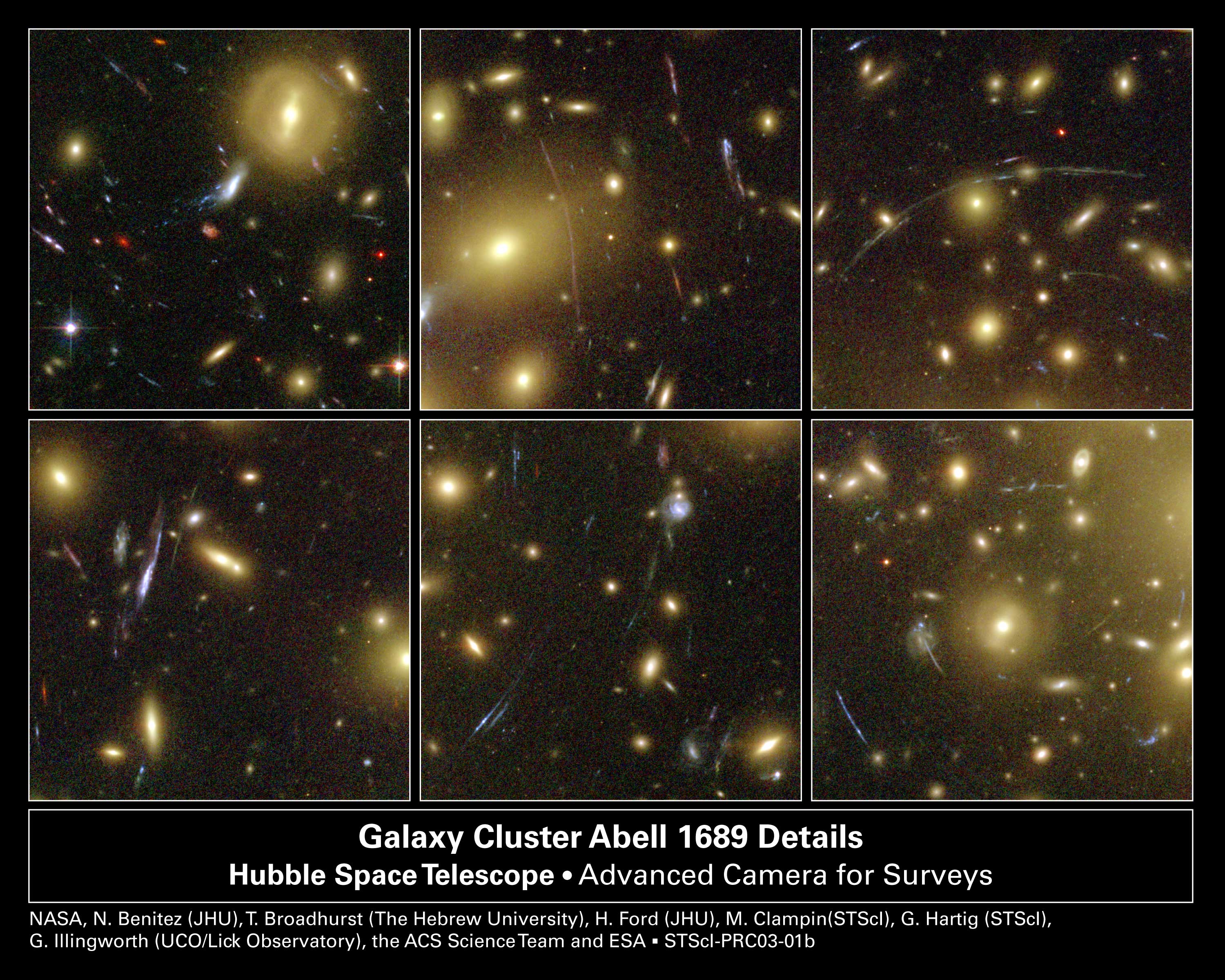
The second reason I like this image is that it helps prove one of the predictions made by Einstein’s theory of general relativity: gravitational lensing. The image at left shows a detail of Abell 1689 with some faint arcs (actually partions of “Einstein rings“) that are actually caused by light from extremely distant galaxies (some 13 billion light years away) being bent by the massive galaxy cluster. The mass from the trillions of stars along with dark matter has caused the light to bend making the mass act like a lens (Einstein predicted that mass could warp space and therefore bend light). The third amazing thing that this photograph helps to prove is the existance of dark matter. The amount of mass from the galaxies (and the stars within) anly account for approximately 1% of the matter needed to bend the light as much as it does. Dark matter is extremely interesting and has large implications for cosmology, but that is a discussion for another day.
Visit my Space Saturday Archive for other cool astronomy pictures!
Resources
HubbleSite: Biggest ‘Zoom Lens’ in Space Takes Hubble Deeper into the Universe
HubbleSite: Images of Abel 1689
HubbleSite: Image of Abell 1689 Details
SpaceImages.com: Hubble Abell 1689 Photo
APOD: Abell 1689 Warps Space
APOD: Abell 2218: A Galaxy Cluster Lens
NASA: Goddard Space Flight Center: Gravitational Lensing
Wikipedia: Gravitational Lensing
Wikipedia: Dark Matter
HubbleSite: Dark Matter
-Matt Jones




I wish I knew more about astronomy . I find it so interesting.
Well you can always find out more. It is extremely interesting!
Hey Matt..I’m hoping this counts for a blog comment and a reminder notice! Your group is on for childcare during chapel on the 29th of Nov.
Have a good weekend, Jackie
That’s an awesome pic. It’s pretty amazing to see hundreds of galaxies in such a small space, and the lens effect makes me think we’re looking at the universe from inside a time tunnel. Looked at that picture for maybe ten minutes and still can’t put into words what I think about it.